
Product overview
What is Joseph’s Well?
Joseph’s Well is presented as a downloadable DIY information package. The seller describes step-by-step video lessons, printable blueprints and drawings, a materials list, guidance for mains-powered and solar configurations, email support, and bonus material about water storage and treatment. Nothing on the verified landing page suggests that the buyer receives a completed atmospheric water generator in the mail.
The queue identifies the offer as “Joseph’s Well – NEW CINEMATIC VSL - Blockbuster Offer” from ClickBank vendor USWATER1. The classic HopLink opened the matching Joseph’s Well page, which names ClickBank as a retailer and states that “John Gilmore” is a pen name. That disclosure matters because a buyer is assessing a publisher’s instructional package, not independently verified credentials attached to a public engineer or water professional.
The idea behind the project is straightforward: cool humid air below its dew point, collect the condensate, then treat and store it. EPA and U.S. Department of Energy materials confirm that atmospheric water generation is a real technology. They also stress that yield changes with temperature and humidity, power demand can be significant, and collected water needs a complete safety plan.
What the seller says is included
The seller presents a sequence from choosing parts through assembly. Video can be helpful for readers who learn better from demonstrations, but it cannot replace local electrical and plumbing rules or qualified help.
Printable drawings and sourcing notes can reduce guesswork. Before buying parts, compare every component’s electrical rating, food-contact suitability, corrosion resistance, and cleaning access with the design.
The offer discusses conventional power and an off-grid solar setup. “Solar” does not mean free unlimited output: panel capacity, batteries, inverter losses, compressor start-up demand, weather, and local humidity all affect performance.
Bonus guides cover reserve planning, purification, and mineralization. These topics are essential, but a guide’s presence is not proof that the finished DIY system meets a drinking-water standard.
The seller advertises help with build questions. Verify the response channel, support period, and whether advice covers safety or only the guide’s written steps.
Does atmospheric water generation work?
Yes, the physics is established. A condensation-based atmospheric water generator draws air over a cold surface. When that surface is below the air’s dew point, water vapor changes into liquid water. It is closely related to the condensation seen on air-conditioning coils or in a dehumidifier.
The difficult part is not proving that droplets can form; it is producing a useful quantity efficiently and safely. EPA’s technical brief says home-scale systems can produce roughly 1 to 20 liters per day, while commercial units can be much larger. Those are broad technology ranges, not a performance promise for Joseph’s Well. EPA also states that output depends heavily on air temperature and humidity. The Department of Energy similarly notes that climate affects yield and that colder, humid conditions can require more energy than warmer, humid conditions.
That is why a headline such as “40 gallons a day” should not be treated as a planning number without test conditions. The seller’s own materials and current third-party coverage show differing output figures across pages. A careful buyer should request the guide-specific expected output at stated temperature and relative humidity, together with watts consumed, test duration, component specification, and treatment method. Hotsia Product Reviews has not independently verified a daily-gallon figure for the DIY build.
Water safety is a system, not a filter alone
Atmospheric condensate is not automatically sterile. EPA’s study of a commercial atmospheric water generator found no Legionella or Mycobacteria in weekly samples from that particular unit, but it also found high heterotrophic bacteria levels and emphasized that condensate should be adequately treated before potable use. The result cannot be transferred to a different DIY design, and it does not certify Joseph’s Well.
Air can carry volatile compounds, dust, smoke, pollen, microorganisms, and other contaminants. Water can also pick up metals or residues from coils, tubing, solder, tanks, sealants, and cleaning products. Warm storage, stagnant plumbing, dirty filters, and poor sanitation create opportunities for microbial growth after collection.
The CDC explains that different treatment methods remove different hazards. Many ordinary carbon filters improve taste or remove some chemicals but are not designed to remove all bacteria, viruses, and parasites. UV treatment can reduce germs when properly sized and maintained, yet it does not remove chemicals. Reverse osmosis can remove many germs and some chemicals, but performance depends on the specific certified system. A safe design needs source assessment, compatible materials, suitable treatment, disinfection, hygienic storage, maintenance, and periodic testing by an appropriate laboratory.
Do not drink water from a newly built unit merely because it looks clear or tastes normal. CDC notes that harmful germs and chemicals may not change appearance, taste, or smell. Local health departments, certified water-testing laboratories, licensed electricians, and qualified plumbing or water-treatment professionals are better sources for site-specific decisions.
Price, build cost, energy, and the 60-day policy
The seller uses multiple landing-page options, so the live checkout controls the guide price. The affiliate center lists VSL landing pages at $67 and $39 price points plus a text sales letter. Confirm the selected page, final one-time charge, currency, taxes, optional offers, and exactly what files are included before paying.
The seller positions the hardware as obtainable from ordinary stores, but the true project cost is more than the parts list. Include replacement filters, disinfection equipment, water testing, food-grade storage, electrical protection, ventilation, tools, solar hardware if used, electricity, cleaning supplies, and repairs. If professional help is needed, include that as well.
The current return page publishes a 60-day money-back policy. It also contains language about returning “the product” and a physical returns address, even though the core offer is described as digital plans. Keep the ClickBank receipt and ask the seller or ClickBank to clarify the process that applies to your order, the deadline, and whether any physical item must be returned.
CBSnooper’s marketplace statistics are third-party promotional data. They can help confirm the vendor identity and offer activity, but they do not prove guide quality, water output, this site’s sales, or a buyer’s result.
Who may find Joseph’s Well useful?
Potentially positive fit
- You want one structured introduction to a DIY condensation-based water project.
- You are comfortable sourcing components and checking technical requirements.
- You understand that output will change with climate and operating conditions.
- You will treat generated water, maintain the system, and arrange appropriate testing.
- You want a digital guide and will verify the final price and return process.
Consider another route first
- You need a certified, ready-to-use appliance rather than instructions.
- You need guaranteed daily output regardless of humidity, temperature, or power.
- You need emergency water immediately; stored safe water is more predictable.
- You cannot safely complete electrical, refrigeration, plumbing, or sanitation work.
- You expect a DIY guide by itself to certify water as potable.
The strongest use case is education and project planning. The weakest use case is treating a marketing headline as a substitute for a site-specific water plan. Even a successful atmospheric generator should sit inside a broader preparedness strategy that includes stored water, backup treatment, power-loss planning, and local public-health guidance.
Buyer checklist before paying or building
- What exactly arrives? Confirm whether the purchase is digital-only and list every video, PDF, drawing, bonus, and support feature.
- Which output figure applies to this build? Ask for measurements at stated temperature, relative humidity, runtime, and power consumption.
- What components touch the water? Check coils, tubing, fittings, tanks, sealants, and filters for appropriate materials and cleaning access.
- How is water treated? Identify filtration, disinfection, storage, maintenance, replacement intervals, and testing—not just one filter stage.
- What is the complete cost? Add parts, tools, electricity, solar hardware, treatment, lab testing, maintenance, and professional work.
- What happens during an outage? A powered system is not an immediate emergency source when electricity and batteries are unavailable.
- What rules apply locally? Building, electrical, plumbing, rainwater, and drinking-water rules vary.
- How does the refund work? Save the receipt and clarify the 60-day instructions for the specific digital or physical order.
Vendor, HopLink, image, and promotion rules
The verified classic affiliate URL is https://hop.clickbank.net/?affiliate=amcrep01&vendor=USWATER1. It redirected to the matching Joseph’s Well page and added an opaque hopId. This confirms the public route and product match; it does not expose or prove account-side ClickBank tracking or commission credit.
The official affiliate page states that social and search traffic are allowed, with one clear search restriction: affiliates must not bid on “Joseph’s Well,” “Joseph’s Well review,” or similar brand terms. Its terms also require original content, forbid copying or paraphrasing the seller’s site outside provided affiliate materials, require clear affiliate identity, prohibit seller impersonation and retail-marketplace resale, and limit email promotion to opt-in traffic. This page uses organic editorial SEO, an original illustration, and attributed seller claims.
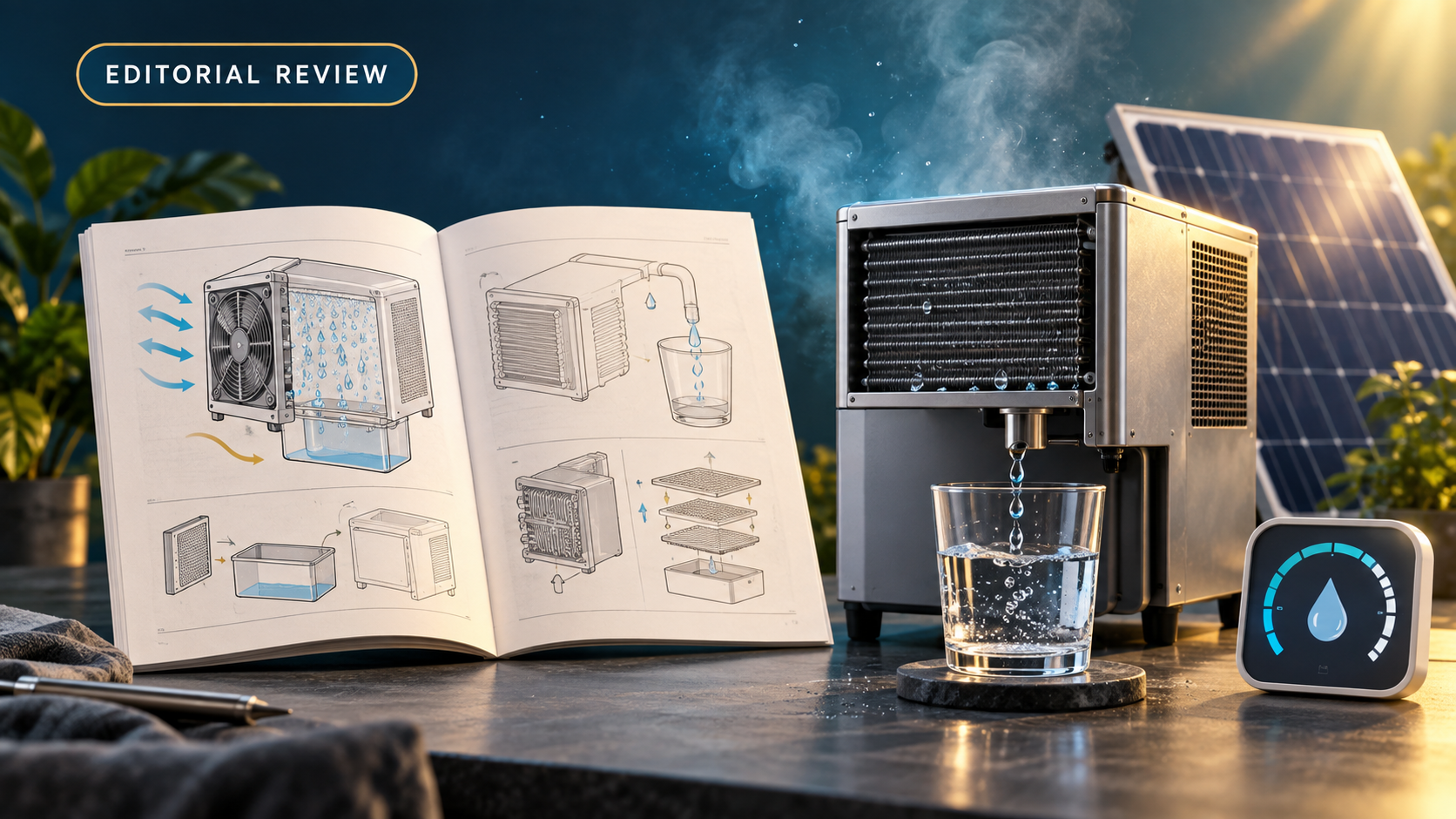
The featured image was created specifically for Hotsia Product Reviews. It does not reproduce the seller’s bundle artwork, logo, interface, screenshots, or finished-device imagery. Its “EDITORIAL REVIEW” badge makes the image’s purpose explicit.
Joseph’s Well FAQ
Is Joseph’s Well a finished water machine?
No. The verified offer is presented as digital instructions, videos, blueprints, a materials list, support, and bonus guides. Buyers source and assemble hardware separately.
Can water really be collected from air?
Yes. Condensation-based atmospheric water generation is established technology, but output depends strongly on temperature, humidity, equipment, airflow, runtime, and energy.
Does the guide guarantee 40 gallons per day?
Hotsia Product Reviews found no independent test that verifies that figure for the DIY build. Use guide-specific measurements under stated conditions, not a headline, when planning.
Is collected water automatically safe to drink?
No. Atmospheric condensate can contain contaminants and support microbial growth. The completed system requires appropriate treatment, hygienic storage, maintenance, and testing.
What does Joseph’s Well cost?
The affiliate center lists $67 and $39 landing-page options, but the seller can change funnels and add optional offers. The live ClickBank order summary controls the final charge.
Is it a subscription?
The core guide is presented as a one-time purchase. Confirm the order summary and any upsell before submitting payment.
What is the refund period?
The seller’s return page publishes a 60-day money-back policy. Because its wording mixes digital and physical-product language, keep your receipt and confirm the instructions for your exact order.
Is the solar option completely off-grid?
That depends on the equipment and climate. Panel output, batteries, inverter capacity, compressor start-up demand, weather, and required runtime all matter.
Sources and review method
This desk review was prepared on October 2, 2026 from the verified Joseph’s Well seller page, its official affiliate resources and terms, the seller’s return policy, the matching classic ClickBank HopLink for vendor USWATER1, and the public CBSnooper listing.
Independent technical and safety context came from the U.S. EPA atmospheric-water-generation evaluation and technical brief, the U.S. Department of Energy page on alternative water sources, and CDC guidance on home water-treatment systems and choosing water filters.
Seller pages, files, prices, optional offers, support, and refund instructions can change. The live checkout and delivered materials control the purchase. A qualified professional and local authority should guide electrical, plumbing, construction, and drinking-water decisions.
Review the current Joseph’s Well offer
Open the seller’s page to verify the guide format, current price, delivered files, support, and refund process. Compare those details with your climate, energy budget, water-safety plan, technical skills, and backup supply before deciding.